
 LISTEN NOW!

“Anybody could just start banging rocks together and express themselves,” Don Haugen told us. “Anyone can make noise.” That’s a pretty good entry point for a music form that a lot of people assume isn’t really for them.
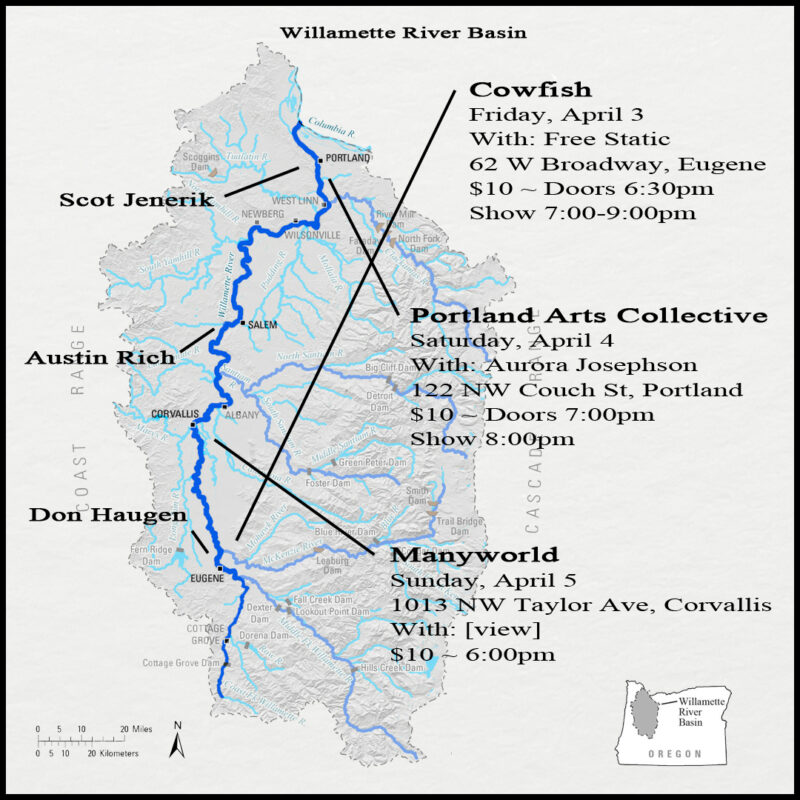
Next week, four artists with a combined century-plus of experience in noise, experimental sound, and sonic art are hitting three Oregon cities for three nights — Eugene on April 3rd, Portland on the 4th, and Corvalis on the 5th. Scot Jenerik, Don Haugen, Austin Rich (Mini Mutations), and Aurora Josephson sat down with us on Missed Connections ahead of the run, and what was supposed to be a quick pre-show conversation turned into one of our favorite long form interviews with more content than we had time to air. What follows is that conversation… the long form version.
For those of you in the PDX metro, their showcase is at Portland Arts Collective, 122 NW Couch Street, in Old Town/Chinatown on April 4, 2026 at 7pm. All ages, safe space, no one turned away for lack of funds. That’s the scene these folks are building.
For everyone else, the show is up on MixCloud.
For folks who might be unfamiliar with experimental sound work, how would you describe this tour and what you’re all doing together?
Austin: It’s a bit of a showcase. Three of us are at all three events (myself, Don and Scot), and then we have a different performer joining us at each one. Aurora is joining us in Portland, we have an artist named Curtis joining us in Corvallis, and a duo called FreeStatic in Eugene. So there’s a core team with a rotating guest each night.
How do you all know each other?
Scot: It goes way back through the sound art and noise scene. Don and I have known each other since at least the early ’90s. Austin and I first met at the festival in Eugene that Don put on — at the WOW Hall. And Austin is a phenomenal DJ and interviewer in his own right. He’s been generous enough to care about what I do and have great conversations together about it. Aurora I’m actually meeting for the first time right now.
Aurora: I think we might have met in the Bay Area a long time ago. If you were there anywhere between ’92 and 2018, I was there.
Scot: I was there from ’88 to 2013. Did you ever go to anything with 23five Incorporated?
Aurora: Yeah.
Scot: I founded and ran 23five. That was my organization. Which is maybe where I met Don, too, possibly. But we had you down for stuff as well. It’s a scene — the thing about it is, it’s kind of called the noise scene, but it’s not really noise anymore. It’s like how punk rock started out as this broad platform where the Talking Heads or Blondie could be considered punk. And then once bands like the Germs and Dead Kennedys and mostly Black Flag took on this more hardcore element and toured relentlessly, all of a sudden punk became hardcore, and anyone who wasn’t part of that earlier scene was no longer accepted. The nice thing about the noise scene is even though it’s fragmented to some degree, there’s still a core power electronics scene, but everyone else around it — everyone here does this for the love of it. Nobody’s making money off this. We’re not paying our bills off what we’re doing. So the camaraderie around it is infectious. You meet somebody and it’s like, oh, you’re into this too? You like weird sounds? And you instantly become friends. I tour all over the world doing this stuff and meet amazing people everywhere. Once you meet people like Don and Austin and now Aurora, you’re just part of this family.
Don: I consider Scot and Austin friends and now Aurora. I just met her. But it’s kind of like the nerds’ table at the cafeteria in school. All the misfits stick together. Power in numbers. Maybe small numbers, but still.
Where do you think the noise begins?
Scot: There have been interesting dissertations about this — where things began. You’ve got to go back to Russolo and the Futurists and the Art of Noise. I actually did a speech on this at the Museum of Modern Art (SF MOMA) during a Sound Culture Festival, talking about the different quadrants of where people approach sound in a noise context. From my direction, I came from a fine arts background. I have a master’s degree from the San Francisco Art Institute in visual arts, but I primarily use sound as my medium. Then you had Mills College, which was another huge institution coming from academia — the John Cage tradition of: how can we disrupt normal music in a way that’s going to be really interesting. And then you had Japanese noise, which is basically: what if we plug these two wires together and get an explosion? What could that be? Those were the core rumblings, at least in the mid-’90s, and things have just fragmented out from there.
Austin, you mentioned that things start in one way and evolve over time. Can you talk about how each of you has moved beyond what might strictly be called noise?
Austin: I think each of us have music that probably isn’t strictly noise per se, but it all stems from a similar place of inspiration and ideas. Things evolve. And I think that’s what keeps it interesting.
Scot: Right now I’m playing a Turkish instrument called a saz baglama, playing notes and melodies — but I’m really messing them up. Sometimes they’re accessible because they’re normal notes people would think of as music. And then there are times where it’s like, how are you chopping the sound up so much? Why is this disintegrating? Everything evolves and we’re always pushing forward to the next phase, the next possibility. After a while you get bored doing the same thing. It’s time to move on and look for new realms.
Don, you work quite a bit with home-built electronics and repurposed instruments. What draws you to creating your own tools versus using conventional gear?
Don: It started with necessity — not having the money to buy some of the stuff. But I also like creating new things that don’t exist. I use a lot of test equipment in a way it’s not meant to be used. It has a really robust sound with lots of overtones. A lot of it is 60 years old or older, so it has natural analog glitch that you don’t get anywhere else. Started off as necessity, then I just fell in love with it.
Is there something about analog sound specifically that attracts you over digital?
Don: Oh my god, yeah. If you fire up an HP 200 CD oscillator — a tube oscillator with a built-in tube amplifier — it does a sine wave, nothing else. It’s got a volume knob and a frequency knob. The knob itself is about eight inches around. You run that through a subwoofer and there’s nothing like it. It’s so harmonically rich. It’s warm and it’s so imperfect that it’s beautiful. It will never be the same twice. If you run a digital signal, it’s so pristine and clean. It makes me sick.
The magic is when you get two of those machines together and they’re close enough in frequency that they create their own beat frequencies, and they drift — it just takes you someplace else. I don’t know how to describe it. It’s like listening to the ocean versus listening to a noise machine next to your bed. There’s no real comparison.
Your work ranges from very dense sounds to very quiet, whispering tones. How do you decide what sonic territory to move into for a given piece?
Don: For me it’s pretty emotive. You’re telling a story. You have to have contrast, some textures. Sometimes there’s a buildup or a fall down, and sometimes both of those are happening at the same time. I compose the pieces in my mind, how I’m going to approach it. I’ll write them out often. There’s actually a start and a finish. It is composed.
Aurora, you have operatic training — a BA and an MFA from Mills College. How does that classical foundation connect to the experimental work you do now?
Aurora: You could look at it this way. For me, I started opera as a base, a platform through which I could get to other spheres — mainly improvisation. I don’t really like a lot of the classical opera I studied to begin with. The German art songs I could do without. But I really like modern opera. I use the training as a platform. It seeps in in other places, too. I used operatic styles in my interpretation of John Cage when I performed with the Merce Cunningham Dance Company, for instance. The styles inform the noise work. But opera is the platform by which you get there.
You also do a lot of visual art. What does it look like balancing that with sonic art?
Aurora: Well, right now I have this amazing mountain of smut that I was gifted. I am called the Kink Disposal Unit and it’s my very first solo act. I’ve never performed solo before. I’m sitting on over 20 boxes of all kinds of kink material — periodicals, suggestive imagery, BDSM content. And I’m digesting it. I’m taking the imagery, I’m reading it, and I’m also using my Akai two-track to make extended techniques and record them as a backing track while I read all of this pretty incredible material. That’s what’s going on there.
Scot, tell us about how you decided to press a concrete vinyl.
Scot: It started when I was on tour in 1996 and I was at somebody’s house in Seattle. They had metal pressing plates for pressing vinyl — first time I’d ever seen them. I’d already been doing a ton of work with cement, so I had the thought: it’d be really interesting to actually make an album out of cement.
The initial version was Mozart’s Requiem, and it ended up sounding like a transmission from Marconi in 1904 — this ethereal sound coming out. And it was backwards, so it was the black mass. For about 20 years I tried to find the right piece of audio to embed in the concrete. At one point I jackhammered the cement pad at a warehouse in San Francisco and thought that would be perfect. But it was too obvious. Everything I came up with seemed like I was just placing sound there for no specific reason.
Then I saw the movie Let the Right One In — the Scandinavian vampire film — and it blew me away. I decided to write an alternate soundtrack for the vampire Eli. This short piece came out and I was like, this is perfect. When you cast cement against a surface, it picks up that surface, so it ends up being what you play. It’s very gritty, a lot of surface noise. It feels like you’re underground when you’re listening to it. One of those projects that just took a long time to come together, but eventually did.
Definitely not something you want to break out your finest stylus for.
Scot: No. I have a secondary turntable for that album. But unlike the punk rock albums that were coated in sandpaper, it’s not meant to destroy your stylus. It’s more about integration. I’m very much a direct, elemental-contact kind of person. I like embedding sound in physical material. One of the other things I started out doing was building instruments that would blast fireballs. I’d be doing percussion instruments engulfed in fire, or drumming on flaming sheets of steel with my bare fists. The progression has been very elemental. The initial sound source has to be something physical. I’m not against digital — all of my effects are digital. It’s just that the initial source has to be physical. I think that’s what it is more than anything else.
Austin, you’ve worked quite a bit with zines and physical media. Tell us about how that collage sensibility turned into music.
Austin: I started making zines in high school. I saw one, I read it, and the next day I knew I was going to make one. It was a pretty instantaneous conversion. I got really into collage in zines because it was this wrestling with physical media — you’d take magazines, find things you could cut up and turn into something else, and that becomes pages in this larger piece.
After college it occurred to me: why am I not applying this collage to music and radio? So I’m kind of the outlier in this group in that I’m cutting up the media and music and movies and TV around me and trying to make new things out of it. The computer is one of my bandmates, in a way. I perform the bass parts and analog synthesizers, but the computer helps with samples and beats. That was really my focus — what if I took this collage idea that ignited my mind as a young person and tried to do an audio version of it?
The music we played on the show has these big narrative arcs — almost operatic, storyful. How do you pull together something that starts as collage into a cohesive piece?
Austin: It takes a long time, I’ll be honest. I got a writing minor in college as part of wanting to take apart how stories work so I could make my own. And I realized that when you’re doing a collage, you’re doing that in a very primitive way. You’re like, I like this piece over here, but it has to go first because this other thing later references it. As you assemble it, a story starts to develop even if you’re trying to avoid one. We have this incredible ability to find connections between things even when there is no connection whatsoever. You string together three samples from any three places, and sooner or later you start to hear how they connect when you hear them enough times in a row.
Sometimes you’ve got to listen to it 500 times before you hear where something needs to go. So there’s a lot of listening, comparing, going back and forth. And sometimes you’re like, I’m going to play the bass for a little while because I’m stuck and I need inspiration.
You’re all in the same universe, but the work is wildly different. What does it sound like when you’re together, performing back to back?
Austin: A few of us have played together in different combinations, but never in this particular arrangement. There are going to be a lot of question marks as we run through this and see how it works out.
Scot: When you group certain people together for a tour or for shows, you’re already curating what it’s going to be. We all approach things from a slightly different direction, but we exist close enough in a realm that it creates a cohesive evening. We’re different enough that it makes it not boring — you’re not having the same thing four times. But it’s four acts doing things that are close enough in relationship to create a homogeneous kind of night. I was just in Japan last September touring with Joseph Hammer and Thomas Dimuzio, and there were nights where the combination of extreme power electronics to floaty sounds to Buchla-laden stuff created a really broad range. And it was brilliant every single time.
For anyone listening who may not be experienced with experimental music, what would you want them to know for their first engagement with this sound?
Scot: One of the best things anyone ever said to me was after a show in Chico. This guy came up and said, “It’s not that I didn’t know this was possible — I didn’t know this existed.” And he said it was a phenomenal; a door-opening for him to understanding a different way of listening.
Aurora: Just keep an open mind. You don’t know what’s possible. There’s a lot that’s possible that you may not know you liked. Come with an open mind and an open heart.
Austin: I had a show not too long ago at an art gallery where afterwards somebody said, “I didn’t think you were going to get that political or that I would want to dance that much.” That was never really my goal, but every once in a while I’ll throw a beat in, and politics as well.
Don: I think it’s surprisingly approachable music, to be honest. There’s so many different kinds of experimental music being made — there’s something for everybody. People may already be listening to experimental music and not even know it. Industrial music influenced Madonna. It really is everywhere. It’s got a longer history than rock music. For me, this kind of stuff is taking academic thoughts about what avant-garde music is and making it street-level, making it accessible to anybody and everybody. As in punk, I think experimental music is truly the most punk of all because anybody can do it. Anybody could start banging rocks together and express themselves. Anyone can make noise.
Scot: The best thing about noise is anybody can do it. And the worst thing about noise is anybody can do it. But fortunately, within this particular show, you have seasoned veterans that have dedicated 30-plus years of their lives to this.
Aurora: And one beginner. But come on. I’ll wow you.
Austin: They used to make that same comment about improv comedy, and eventually improv comedy became the primary form of comedy in a lot of circles. So just wait. Experimental is taking over.
Scot Jenerik is a composer and conceptual artist based in Portland, OR. Find his work at scotjenerik.bandcamp.com.
Don Haugen is a sound artist and curator based in Eugene, OR, and founder of the Eugene Noise Fest — find him at donhaugen.bandcamp.com.
Austin Rich performs as Mini Mutations out of Salem, OR — find him at austinrich.org.
Aurora Josephson is a vocalist, printmaker, and photodocumentarist based in Portland, OR — find her at aurorajosephson.com.
The Portland Arts Collective is at 122 NW Couch Street in Old Town/Chinatown —portlandartscollective.org.
