

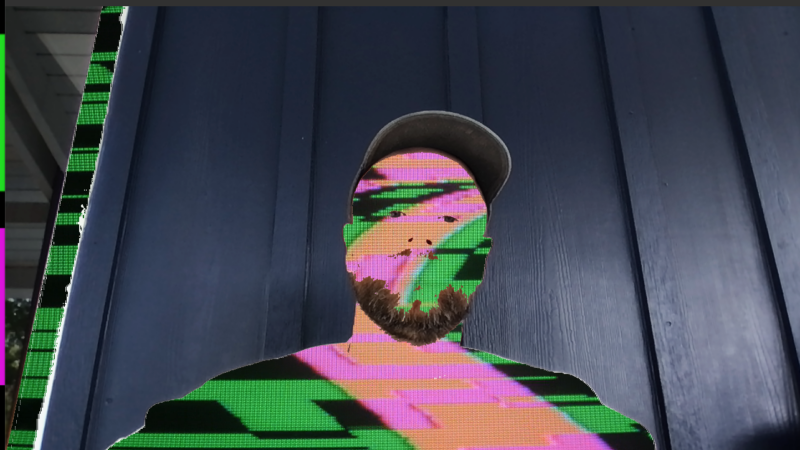
There aren’t many musicians who can draw a straight line from 13th-century polyphony to Detroit techno. Sean Russell Hallowell is one of them, a modern day Renaissance man–composer, video artist, and teacher. Based in the Bay Area, Hallowell performs under the name Isorhythmics, blending hand-built analog instruments, live video synthesis, and an unconventional sense of time into something that’s genuinely hard to categorize.
His new album, Delicate Citadel, is the distilled product from years of live performance. It’s a record that rewards patient listening in an era that’s engineered to prevent it. We caught up with him to talk about the making of the album, his unlikely path into electronics, and why he’s never once spoken to a chatbot.
You can listen to the full episode here and catch Missed Connections on the dial every other Saturday from 8-10pm.
Your new album, Delicate Citadel, came out of a live A/V show you’ve been touring for a couple of years. How did a live performance become a studio record?
The whole album is technically meant to be listened to front to back. I know, big ask these days. The live set is a continuous 45-minute piece where I’m playing samplers and MIDI keyboards while making analog visuals live and projecting them. Over a couple of years of playing it out, mostly on the West Coast, it slowly congealed. What I ended up with was a kind of chopped-up version of that continuous set. I did think about portioning the tracks so they could be self-sufficient, but there are sides to it. Cassette mentality. I’m old like that.
People who know you primarily as a video artist might be surprised by how lush and orchestrated it sounds. Were you surprised?
I always love hearing what people expected versus what they actually got, because it’s so revealing. And yeah, I was a little surprised. My background as a performing musician was in bands, guitar, post-punk stuff. I had a band in college called the Stay at Home Dads, which at this point exists mainly for the name. I really liked Gang of Four, so I was just trying to sound like a British band from the late ’70s. But when it comes down to it, I’m a kid from the ’80s. I like a poppy melody. I like a catchy phrase.
So where does the lushness actually come from?
The foundation is really drum loops I made on an analog drum machine I built by hand from scratch. Ninety percent of the drum sounds on the album are recordings of that thing, chopped into samples. Then I used Max/MSP to layer things on top, and as I played it in different venues and contexts, the form grew organically. Maybe lush like an overgrown garden. Things built on top of each other over time, almost like sediment.
You mentioned a “secret past life” studying medieval and Renaissance music. How does that connect to an electronic album?
Most of the melodic parts in the album are pretty direct lifts from music written between the 13th and 16th centuries. I’ll take a chunk of a melody and do variations on it. But beyond the sampling, there’s a bigger picture connection I’ve never really had the chance to articulate. What ties medieval polyphony to house and techno for me isn’t just the formal stuff, though the polyrhythms are real. It’s that both are after a different kind of temporal experience. They’re not counting one, two, three, four. They’re not doing the standard metrical Western thing.
Can you say more about that?
Before around 1600, Western European music was kind of the wild west. There was no four-four, no I-IV-V progression. The language of composition had way more freedom in how rhythm and harmony were treated. When I first started listening to it in grad school, it blew me away because I couldn’t relate it to anything I’d heard before. It sucked me into a different realm. And that’s exactly how I feel listening to house and techno. Most people who really get into rave culture would say the same thing. You go in, eight hours pass, and it feels like a blink of an eye. It’s an altered state. The formal stuff gets you there, but it’s also the intention behind the music. All of it is ritual music, really.
You build your own instruments. How did someone with no engineering background end up soldering drum machines?
The more I worked with computers making music, the more I wanted to work with hardware. The more I worked with hardware, the more I wanted to control things the hardware wasn’t letting me control.
I took a DIY synth class, and that was the push I needed. When you’re doing electronics for the first time, the hardest part is just believing you can do it. It feels like dabbling in forbidden knowledge. There are so many ways to go wrong. What you need is someone to say: don’t worry about that, don’t worry about that, just focus on this one thing and get it working.
What really hooked me was video synthesis. Taking the oscillators we built for audio and plugging them into CRTs. Once you start constructing composite video signals, building form and pattern off of that, you’re suddenly on an engineering crash course. I basically spent most of 2020 in my basement until five in the morning learning this stuff. Composite video is technically so demanding that it leveled me up in ways that made audio feel almost basic by comparison.
Let’s talk about the music you picked for Missed Connections. The selections span from minimal techno to 15th-century chamber music. When you’re seeking out electronic music, what are you actually after?
I didn’t even really listen to electronic music until about eight years ago, when I started performing it. Before that I was making electroacoustic music. Think the sound of glass breaking, reversed, dispersed across a wide stereo field. Scary sound effects music. I learned all the tools but I wasn’t making music I actually liked. Then I got into a scene in the Bay Area with people doing live code, more techno and house stuff, and through hanging out with those folks I pieced together what kind of electronic music actually works for me. Minimalist. Really sparse. Robert Hood, Jeff Mills. That world.
You gave a lot of credit to your collaborator Ryan Smith, aka Taraval, for opening that door.
Ryan produced Delicate Citadel and he’s just an incredible musician all around. He plays in Caribou, he’s been making electronic music for decades. He told me about this techno scene that came out of Hamilton, Ontario, this suburb of Toronto that was close enough to Detroit that people would go see shows there, then go back and try to recreate it in their warehouse scene. Ryan jammed me some of that stuff and I was like, okay, I get it now.
You’ve been pretty vocal about never having interacted with an AI tool. In a city like San Francisco, that feels almost impossible.
I know, I’m bombarded by this stuff. I’ve never asked a question of any chatbot, never put anything into Suno. Although I should say I’ve been present while other people have. I’ve heard it.
So what’s your actual position on AI music?
I go back to my training in the history of philosophy and my belief in the reality of consciousness. Consciousness is a pre-given element of existence. It’s not something you can synthesize. That’s kind of the whole point of it. So, I’m not sitting here worried about Terminator 2, and for the same reason I’m not worried about AI ruining music. I do think there are real danger zones. If you’re a sound designer making music for commercials, yeah, AI is going to take your job. You can generate stock music on the click of a button. That’s a real issue for people’s livelihoods.
But for music as an art form?
The idea that people don’t actually like making music and this is just saving them from having to do it? That’s just clickbait. In a couple of years everyone’s going to be like, what were we thinking? People making music, people going to see other people make music. That’s never going to die and never going to get replaced. What I do think is real is the audio wallpaper problem. AI is perfect for generating content that exists just to fill silence while you’re on your phone or doing laundry. But that’s a specific functional version of music. It doesn’t have anything to do with art.
You mentioned that making this album actually made you more aware of your own intentionality as an artist.
Yeah. As I was making it, it became really apparent how much I care about structure and making someone listen. Because you’re so overwhelmed with things that don’t demand your attention, and in a way that I find kind of blatantly insulting. I wrung every last bit of meaning out of everything I could get my hands on. Things I listened to at age ten are etched in my soul. So this idea that music and audio wallpaper are the same thing? That’s the big lie at the center of all of this hype.
So that certainly helps to reinforce why you put the album out on cassette.
I took it to this trade show I had an installation at in LA, and it was mainly early-twentysomethings buying my cassette on the spot, knowing nothing about me, just going, cool, it’s a cassette.
I give my kids VHS tapes. Not just because I have them around, but because they can touch them, put them in the VCR. There are no commercials, no autoplay. You have a different, active relationship to the thing you’re watching. That’s what the infinite scroll doesn’t give you.
What’s next? More touring, or something new?
I’m putting out a VHS version of the album with the video component. Same music, but with the visuals from the live show. That should be out in the next couple of months. I’m starting to think about what comes next musically. Touring this set for years has been a way of composing it, and now that it’s done, I’m already itching to apply what I’ve learned to something new. Probably more straight-up electronic music. I’ve been working with Ryan on some tracks that are more traditional techno-house stuff. For me, that’s actually liberating. I don’t have to obsess over every two-second microcosm of a track. I can just be.
Isorhythmics’ album Delicate Citadel is available now on Bandcamp. A VHS edition is forthcoming.
