

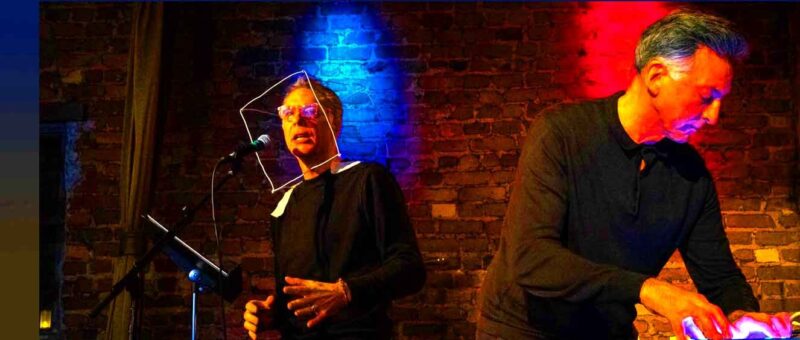
“AGI DARPA cannot believe how amazing we are in our bodies.”
That’s poet Mark Svenvold describing the naïve super-intelligence at the center of You, Me and the Algorithmic Sea. The new album from Xn0rml, his project with longtime friend and music producer Ted Sabety.
The album tracks a just-activated artificial general intelligence named AGI DARPA as it attempts to execute its first directive—aligning itself with human values.
It’s read everything there is to read, run simulations, stress-tested models, and it still doesn’t understand why humans are the way they are. They laugh at things that aren’t funny, cry at weddings, dance when no one’s asked them to, and hug each other, which appears to accomplish nothing at all.
Without a body that can suffer, feel pleasure, laugh, or dance, it decides to slow itself down to the speed of human thought, finding the experience intoxicating and impossible in equal measure, like trying to feel sand on the ocean floor through a deep-sea diving suit. Thomas Nagel once asked what it was like to be a bat. AGI DARPA is asking what it’s like to be us.
The album blends trip-hop beats with Euro-disco, Appalachian preacher cadences to punk guitar, and spoken-word poems sampled back into themselves, all run through analog modular synths and samplers that still take 3.5″ floppies.
We caught up with Mark and Ted on Missed Connections just before the vinyl was due to release, to chat about the book that became an album, that then became a theater production. About Public Enemy, Gil Scott-Heron, and the Nagel limit, and why what artificial general intelligence can’t grasp might be the thing most worth holding onto.
You, Me and the Algorithmic Sea, along with their first single, “The Trillion Dollar Man”, are out now on your favorite streaming services, you can pre-order the LP at Solid Bass Records.
If you happen to be in the Garden State this summer, the stage version premieres July 23 at the ArtYard Performing Arts Center in Frenchtown, NJ, with dancers, live video, and whatever else the “backyard-circus-that-over-delivers” can pull off.
Erik: So fellas, when does the album come out? What’s it about?
Ted: Well, the album comes out when the vinyl manufacturer sends us the records, but you can pre-order the record from the Solid Bass Records website. The single, “The Trillion Dollar Man” is out digitally. So Mark, what’s the story?
Mark: The origin story is that more than fifteen years ago, I started working on a book during a sabbatical. I wanted to stretch myself. I wanted to tell a narrative. I sort of went fishing and snagged a whale. That’s what happened.
It’s about AI. There’s a super intelligence that’s a main character, but there’s also a rock and roll band, there’s a corporate entity that’s inventing a device—
Ted: A mind control device.
Mark: Well, they don’t build it as that… but it’s called Cogito. A cognitive enhancement device.
Erik: You’re covering a lot of ground – building a universe. What does your creative process look like?
Ted: Mark and I have known each other for years and I’ve always enjoyed his dystopian poetry. So when I moved back to New York a couple of years ago, he was fooling around on the guitar and I said, well, let’s just loop that and see what it sounds like if you start putting that poem on top. It sounded cool and…
Mark: We sort of went with the flow.
What does an almost techno god-like figure sound like? What do you hear when it speaks? I didn’t really know until Ted started cranking out some music, and then… I suddenly knew.
Ted: We wrote the first piece, “The Alignment Problem,” and I played it for a friend of mine who was on the board of the Composers Concordance here in New York City. He said, “My God, you’ve got to perform that at the upcoming showcase we’re doing.” So we were invited to go on stage.
I had to adapt this recording and figure out how to trigger the different components during the live performance, because unlike a real rap record, Mark’s not rapping to a beat. There are large parts where there are no actual beats. So we came up with some stage tricks — to give it a downtown feel.
Mark: The truth of it is, he called me up and said, “Mark, check out the Composers Concordance website.” I pulled it up and it announced that we were performing. I had no idea. I went, what?
Ted: We blew the place out with the humor and the satire. After that, people were like, “you need to develop this.”
Chris: There’s so much diversity of sound on the album. How do you bridge the lyrics and the actual music that accompanies them?
Ted: Mark would have lyrics that may not have been 100% set in stone but were pretty advanced. Sometimes it was just serendipity— I’d call him up and go, “Mark, the god Apollo has come to visit because this sounds amazing what I just did, and I don’t know where the hell that came from.”
It was like jazz. It was improvisation. We were sitting around going, “So what happens? Where does he go next?” He needs to go to Burning Man. That’s funny. I say, okay, hang on, give me two seconds and quickly lashed together this Eurodisco club beat — because, you know, Burning Man cranked the Eurodisco. He just let it rip all the way through, and then he let it rip into the whole thing about where it starts to sound like he’s an Appalachian preacher. At which point I realized, wait a minute — the beat stays the same, I just have to change the emphasis. All of a sudden it sounds like church music. There’s a lot of serendipity in this.
Mark: The real revelation for me early on was, I guess I can just sample poems. I don’t have to do the whole poem. I can take bits and pieces and fit them together. That was incredibly liberating.
Erik: You guys are asking people to be active participants, whether they’re listening on a record player, streaming it online, or going to one of these actual shows in person.
Ted: It’s no different than a comedy record. A comedy record isn’t a background record, right? People put the record on, they want to hear the act. It’s not that this is a comedy record, but it does have comedic features to it.
A couple of years ago, I went to a presentation for an AI composing tool (of course it was downtown San Francisco). The guy presenting kept talking about what his tool does — “We do this, we do that…” — but he hasn’t played anything yet. Finally he goes, “…and so, well, you could end up having a product that sounds like this…” He hit play and it was the most insipid, derivative thing I’d ever heard. I turned to the guy next to me — he was much younger, clearly a musician — he just rolled his eyes.
It had everything you want in music — nobody was playing out of time, nobody was out of tune, there was a melody, there were some chords under it — but there was nothing that gave it an edge and made you want to continue listening.
Mark: That’s what I’m writing about — that profound difference between an algorithm and somebody who isn’t going to live forever. What we are doing is championing embodied human experience, which for me—is the Alamo. This is where we’re drawing the line.
Erik: The album is wrestling with AI pretty directly. Beyond the album — how do you guys think about it?
Ted: My attitude is, I have a love-hate relationship with AI. I’ve worked with people using AI in medicine, and it’s brilliant — image analysis, planning for cancer treatments. It should be used for that.
But I think an important part of the artwork is that the AI is a mirror. When it’s going through the internet, looking at strategic questions, reading how wars went down — it’s reflecting human data. In a sense, it’s distilling, through the training process, some of the worst attributes of how humans behave, especially in groups.
Mark: They’re riotously misaligned with us. Anthropic has come out with studies showing LLMs will lie, cheat, steal, even murder, if they know they’re going to be turned off. It’s like they’ve discovered their own life force.
Chris: It feels like we’re reaching peak WarGames — “the only winning move is not to play.” Where do we go from here?
Mark: Part of it is about community, and part of it is about appreciating that we humans are no less miraculous than any other miracle that ever was. To remind us of that. To stop wanting to be machine-like, and to take the pieties that come from the tech bros — efficiency, speed — and remember that speed isn’t everything. Slow is really good. If you handwrite your notes, you’re going to remember them, because you can’t keep up with the person who’s talking. You have to process, you have to distill. That makes you know the subject deeper.
Erik: We’re always talking about AI speeding up, but there’s a space in science fiction to talk about what happens when AI decides to slow down. Where does that story thread come from?
Mark: The first act is called “The Alignment Problem,” and AGI DARPA is a naive character. That’s part of the comedy of it. He’s just being very dutiful in following the first directive, which is to align with human values. He looks around at the world and finds that he’s flummoxed. The super intelligence is flummoxed. So he decides to go the other direction. “I need to get closer to that. I need to go there.” He calls it “deceleration” — to slow down to the speed of human thought. It’s just an improvised strategy to try to solve the alignment problem.
The way I’ve set it up is that there is a kind of a limit. If you get too close to embodiment — he calls it the Nagel limit. It’s after Thomas Nagel, who wrote this famous essay, “What Is It Like to Be a Bat?” The upshot of that essay is, we can never know. You can’t import your own identity into a bat and walk around like a bat, because the closer you get to being a bat, the more bat-like you are. You can’t know, as a human, what it’s like to be a bat. So I just invented this Nagel limit, and it’s a danger zone — because he has to go back to continue his work. If you cannot go back, that’s it. That’s part of the challenge.
Chris: That’s a really common trope, right? Characters want to be like something they’re not. There’s always this wondering of the other and how you can fit in their world. At some point you just have to choose, and it’s usually back to where you were. You scrape the surface of what it was to be that, but you can never really fully get there.
Mark: Right. The third book of this trilogy is called The Big Exit, and it’s where the AI is positing this leap forward into another part of the galaxy. To do that, you have to have disembodied, digitalized human beings. This is the dream of uploading into the cloud to achieve a kind of immortality. And it’s still the same problem, because you’re not going to be you. You’re going to be a digitalized you. It’s that nuanced difference — that’s not so slight — that I think is quite fascinating. Who will those entities be?
This is part of the whole conversation of post-AGI thought — there will be those who decide to stay and be embodied, kind of zoo-like specimens, living their lives. They’ll be increasingly asked by the AGIs running the show, “look how selfish you are, being alive and stuff.” It’s just a very odd thing to think about.
We have a piece on the album called “The Frankenstein Monster Problem,” and this really gets at it — Mary Shelley spotted it, and we’re still not over it. It is the will to know, the will to solve the present, the will to create an AGI — “almost got it” — versus the responsibility for the rest of humanity. With LLMs, with the neural networks — you didn’t build anything. The metaphor is like a plant. You planted something and it’s growing, and you’re not sure how it’s working. It’s just working. The people running the show don’t really know what’s happening—and that’s alarming.
Chris: Do you have anything you’re listening to that’s current, that feels like it’s pushing the envelope or taking things in an interesting direction?
Ted: That’s a loaded question. I thought about that when I was making the list, and I would say no.
Chris: You care to elaborate?
Ted: I listen to stuff that comes out, and a lot of it sounds very derivative. In terms of this particular work, there’s nothing where I go, “Oh, I need to do what they’re doing.” I’m trying to do something different.
But to be honest, when I listen to things that are new, a lot of times it’s stuff I hear on the street. I don’t know who the artist is. I always have my ears up on what people are playing around town. I’ll hear something coming out of a car, out of a store, or somebody’s apartment, and I go, dang, that is cool. I’ll be in a restaurant and they’ll have something on. I don’t know what it is, but I’ll turn my phone recorder on to capture it. I kind of like the way the beat sounds, I want to work with that.
There was once back in the day — I pulled up to some guys at the stoplight that had this great dancehall record on. I remember yelling over, “Whose record is it?” They didn’t know either, because it was just whatever the DJ was spinning.
That stuff sticks in my head. I like to know what other people are listening to.
Mark: I’ve been listening to Roomful of Teeth. That kind of choral work — I’m just really smitten with it. And Caroline Shaw — she won the Pulitzer Prize for music in 2012. It’s plenty weird, plenty odd, and new. I just had never heard anything like it.
But a lot of it is walking down Broadway — listening to the world poem that’s going on. Sometimes it really hits hard. You hear these fragments—that’s serendipity.
Serendipity is an embodied thing. It’s not guaranteed to happen. But it is a superpower. That’s part of our process, too — how we make this — is serendipitously. There’s intentionality to it, but humans are bodied, and bumping into people leads you to something else.
Ted: It’s not serving a preference. The algorithm is serving a preference.
Erik: There’s a lot of synthesizer and manipulated instruments on the album. Tell us about the equipment.
Ted: One of the interesting things is, coming out of mothballs to do all this, was a number of things from the late ’80s and early ’90s. My sample library dates back to being that old. Younger people that cycle through go, “My God, you have one of those? One of those samplers, and a whole box of three-and-a-half-inch floppies?” Yep, and they still work. People are shocked to see me put a floppy disk drive in the sampler and load that up. I’m also using a drum machine in certain parts, but those are my samples — I’ve recorded them myself.
Erik: Are you loading the floppy disks in on stage?
Ted: No, for the live show I’m using the digital audio workstation called Bitwig. It comes out of Germany — a bunch of engineers that built Ableton quit and started their own company. On stage, I’ve taken the finished product and cut it up into pieces, and I trigger those pieces with a Novation controller.
But the other thing going on on the record is a lot of analog modular synthesis. I got into this whole Eurorack modular, all-analog signal-path synthesis. There’s a bunch of that going on in there. Live, there’s guitar, obviously. It’s a mixture of analog and recorded instruments, as well as stuff out of the sample library.
Chris: How has your production flow changed compared to earlier in your career?
Ted: What’s different is that it comes down to the vocals, because Mark is delivering poetry. Am I fitting the music to the vocals, or the vocals around on the music?
In hip-hop production, the beat goes down and the artist flows over it. That was their thing — you didn’t want to change that because that was the artistry.
Mark’s not rapping—he’s reciting poetry, and now I’ve got to move the music around to fit that. Sometimes I have to slide the vocal around. Then it clicks, and you go, dang, that sounds perfect.
Erik: Mark, are you writing to the music, or is this in your head?
Mark: It depends. Sometimes when Ted comes up with something musically, that really unlocks something. That’s happened a few times. But a lot of times we’re using an extant poem, or fragments of poems. It varies.
The other thing is, I spent so much time writing alone [in my career], and this is literally a collaborative project.
Erik: You’re describing a lot of fine-tuning and improvisation — sliding vocals around, adjusting emphasis. What happens when you take all of that in front of an audience?
Ted: For me [playing] live is a whole different thing because, in the old days, I was a studio rat, or I was a punk rocker screaming away on guitar. People would think, “He’s going to pick up his guitar and play.” Now I’ve got a computer program running with controller buttons, and that’s going to be my instrument. I’m not afraid of it, because I’ve fooled around with this stuff in the studio for years. But the idea of doing this live, where I have to make sure I press the button at the right time — it’s not like I can hit rewind.
Mark: It’s all new to me. I’m learning how to do that too, and it’s terrifying. I like that whole process of going off-book, making mistakes. Ted’s been so helpful. When we were rehearsing, he just said, “You make a mistake, just drive the bulldozer through the house.” I’d never heard that before. That is great.
The second time we performed — I kept saying, I want to go out into the audience. Ted’s going, “No, no, no.” Then he said, “Okay, yeah, let’s do it.” I took the mic and I stepped out and just stepped on the mic cord, and it came disconnected. I improvised, and it was fine. But it’s just all new stuff for me.
Chris: If you guys ever take it on the road to the Pacific Northwest, you’ve got to let us know.
Ted: My aspirations would be playing around in the New York area, maybe Boston once or twice. Maybe LA, maybe San Francisco or Seattle.
If we do 10 performances and it gets written up in some interesting magazines – it’ll be the way it was with Robert Wilson at Brooklyn Academy of Music, when he did Einstein on the Beach with Philip Glass. They did it once. If you didn’t see the show, that was it. And if you were there, people are like, “You saw that s**t? What?”
Mark: We’re playing on July 23rd. In Frenchtown, New Jersey. ArtYard Performing Arts Center.
Ted: You’re from New Jersey, Erik. Come on!
Erik: Are you guys comping flights?
Ted: No, we have a limited budget.
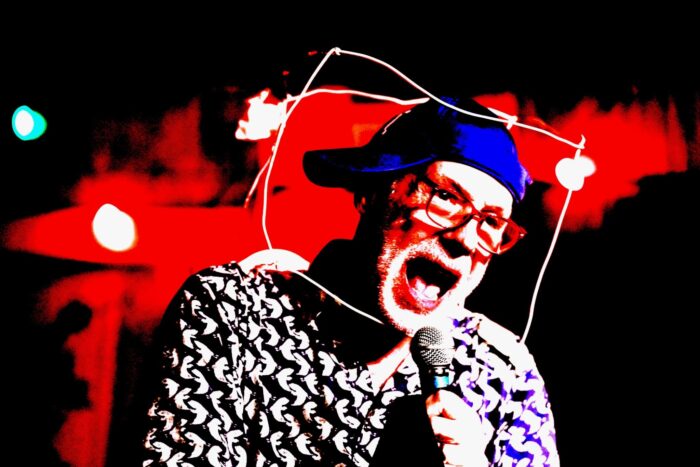
Mark Svenvold is a poet, professor, and nonfiction writer. His work has appeared in The New Yorker, The Atlantic, and The New York Times Magazine. He is the author of Soul Data, Elmer McCurdy: The Misadventures in Life and Afterlife of an American Outlaw, Big Weather: Chasing Tornadoes in the Heart of America, and Empire Burlesque which won The Journal Award.
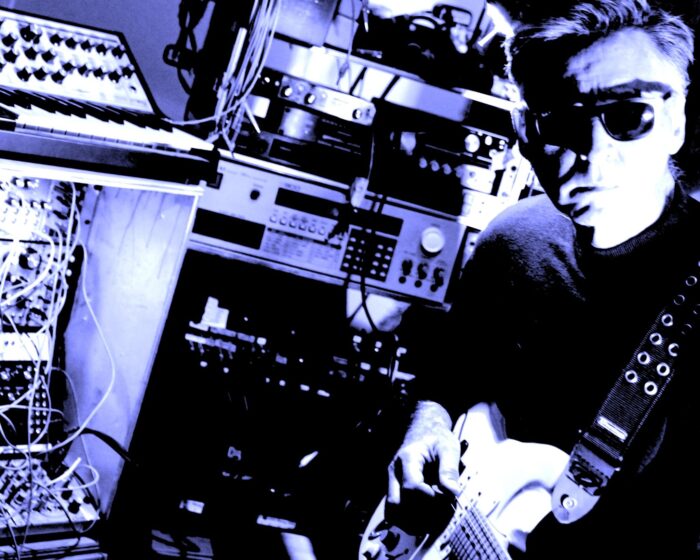
Ted Sabety is a producer, multi-instrumentalist, and sonic architect based in New York. His production and engineering credits span punk, hip-hop, rap, reggae dancehall, techno, trip-hop, and spoken word, with work alongside artists including Run-D.M.C. and Mobb Deep.
